How do you choose running shoes when you’re just starting out?
The Espace des Marques Team | Updated on September 4, 2026
Would you like to take up running but aren’t sure which shoes to wear to be comfortable? Perhaps you’ve already run your first few kilometres in trainers only to realise they weren’t the ideal pair? So how do you choose your running shoes? If you’re just starting out, there’s no need to buy a high-end technical pair at a sky-high price; a versatile, comfortable pair with good cushioning may be enough, depending on your running habits and goals. In this article, we’ll guide you through the criteria one by one, and the brands one by one, to help you choose the model best suited to your running.
Which running shoes should you choose when you’re just starting out? The key criteria
Choosing your shoes based on the terrain you run on
Tell me where you run and I’ll tell you which trainers are right for you! The terrain will have a significant impact on your choice of running trainers. If you run on roads or tarmac – in short, on relatively flat terrain – then opt for road running shoes. They’re designed to absorb repeated impacts on hard surfaces and generally offer a good balance between cushioning, comfort and responsiveness.
On the other hand, if you often run in the woods, along lakeshores, or on uneven or rugged terrain, you’re better off opting for trail running shoes. Their soles offer better grip and their design is suited to rough terrain.
If you like to mix things up, you could choose a versatile running shoe if the terrain remains relatively even, or opt for two pairs – one for each type of terrain. If you’re looking for running shoes on a budget, check out our clearance sale featuring models from leading brands.
Prioritise comfort and good cushioning
When choosing your first pair, comfort should be one of your main criteria. The shoes should feel comfortable from the very first strides, with no pressure points or rubbing.
Cushioning helps absorb some of the impact generated with every stride. For a beginner, a shoe offering comfortable cushioning can be particularly beneficial, especially if you run regularly on roads.
Be careful, though: more cushioning doesn’t necessarily mean a better shoe. The right level of cushioning is the one that suits your body type, your running style and, above all, how it feels to you. The most important thing is to choose a shoe that you feel comfortable running in.
Understanding your running style
Your gait refers to the way your foot strikes the ground and rolls as you run. There are generally three types:
- Neutral gait: the foot rolls in a balanced manner.
- Pronated gait: the foot tends to roll inwards.
- Supinated gait: the foot tends to roll outwards.
If you’re just starting out and aren’t sure of your running gait, a neutral, versatile shoe can be a straightforward choice. If you already know you need more stability, look for a model designed to support you through your first few kilometres.
What is ‘drop’ and how do you choose it when you’re just starting out?
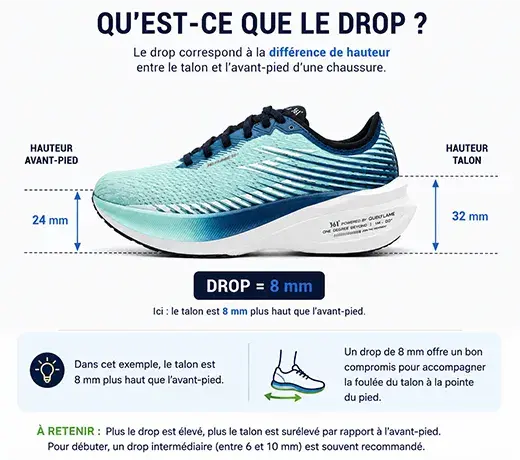
The drop refers to the difference in height between the heel and the forefoot of a shoe.
For example, a shoe with an 8 mm drop has a heel that is 8 mm higher than the forefoot.
The drop affects the feel of your run and the way the shoe supports your stride. When starting out, there’s no need to look for a particularly low or high drop. A medium drop is a versatile choice for your first pair.
Which running shoes should you choose based on your ability and goals?
The ideal model depends mainly on how you plan to use them.
- You’re new to running: A comfortable, versatile shoe
- You run once or twice a week: A versatile pair with good cushioning
- You run regularly: A shoe suited to your running frequency and distances
- You’re training for a 5 or 10 km race: A comfortable and dynamic model
- You’re training for a half-marathon or marathon: A shoe with cushioning suited to long distances
- You’re looking for performance: A lighter, more dynamic model, depending on your level
- You mainly run on trails: Trail running shoes
For your first pair, generally opt for versatility, comfort and cushioning rather than a shoe designed exclusively for competition.
The best brands of running shoes
Several brands offer versatile models that are particularly well-suited to your first few runs.
Asics
Asics, for example, is a well-known brand in the world of running, catering to both beginners and experienced runners. For your first runs, we recommend the Asics Gel-Cumulus. With its neutral support, 8mm heel-to-toe drop and high level of cushioning, it offers the perfect balance for those first runs.
Nike
Nike offers running shoes for different levels and uses, from daily training to more performance-oriented models. The Pegasus range, in particular, is a versatile option for road runs. Its 10 mm heel-to-toe drop and Air Zoom cushioning make it a shoe well-suited to beginner runners.
Adidas
Adidas offers running shoes for all levels. If you’re just starting out, the Supernova Rise is a particularly good choice. Adidas describes it as its most versatile Supernova model, designed for both beginners and more experienced runners. It prioritises comfort and support whilst remaining dynamic enough for daily runs.
New Balance
New Balance is particularly well-known for its shoes offering a good balance between comfort, cushioning and support.
The Fresh Foam X 880 is a versatile option for runners who are looking, above all, for comfort during their daily training runs, thanks to its cushioned midsole.
Hoka
Hoka has made a name for itself with shoes offering substantial cushioning and a particularly thick sole. The Clifton is one of the brand’s iconic models. Its generous cushioning is particularly appreciated on long runs or by runners seeking a feeling of comfort and protection underfoot.
Brooks
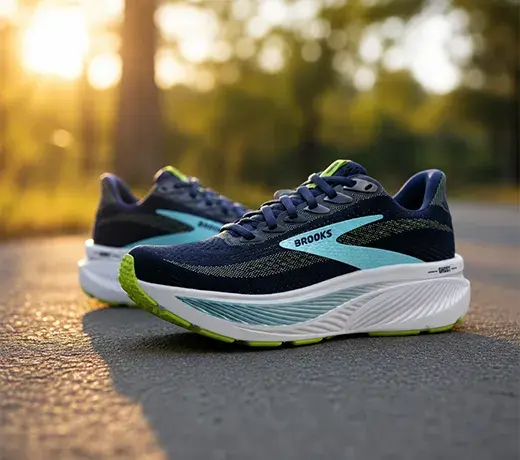
Brooks is a brand specialising in running that offers a wide selection of trainers for daily training. Its ranges allow you to choose between different levels of cushioning, responsiveness and support. The Ghost 16 features one of the highest heel-to-toe drops on the market at 12mm and offers a good balance between comfort, cushioning and stability, making it an attractive option for beginners.
Saucony
Saucony is another well-known brand in the world of running; it offers shoes that are ideal for beginners, such as the Saucony Rise, which features neutral support and a mid-range heel-to-toe drop of 8mm. It combines sufficient cushioning for daily runs with a more dynamic feel as the pace increases.
361°
361° is a running brand that’s more accessible to beginners. With comfortable and versatile models such as the Yushan, it allows you to kit yourself out with a shoe specifically designed for running at a reasonable price.
How much should you budget for a pair of running shoes for beginners?
To start with, there’s no need to invest in top-of-the-range trainers. A good, versatile pair of running trainers will be perfectly suitable for your first few runs. To give you an idea, you can find a good pair of running trainers for around €100 if you’re just starting out.
- under €70 → entry-level / special offers
- €70–120 → good value for money
- €120–160 → more technical models
Clearance sales also offer the chance to find models from major brands at reduced prices, including shoes originally positioned in higher price ranges. For example , you can find 361°, Under Armour or Puma models for under €50 on our clearance website for major sports brands.
When should you replace your running shoes?
People often say you should replace your running trainers every 600 to 1,000 km.
In reality, their lifespan depends on the model, the terrain, how often you run and your weight.
Above all, keep an eye out for signs of wear:
- a heavily worn outsole;
- cushioning that seems less effective;
- a misshapen shoe;
- loss of support;
- the onset of new discomfort or pain.
If your shoes are very worn or no longer provide the same level of comfort, it’s time to replace them.
Buy branded running shoes in the clearance sale
As you’ll have realised, if you’re new to running, choose a versatile pair with neutral support and a medium heel-to-toe drop. The main thing is to find a comfortable pair that will make you want to keep going! You can then upgrade your running shoes as your performance and habits evolve.
At Espace des Marques, you’ll find a selection of clearance running shoes from leading brands, for men and women. Asics, Nike, Adidas, New Balance, Brooks, 361° and many other brands are available, subject to stock.
Take advantage of reduced prices on branded running shoes and find the right pair for your next run.
FAQ
Which brand of running shoes should I choose as a beginner?
There isn’t just one ‘best’ brand for beginners. Asics, Nike, Adidas, New Balance, Hoka, Brooks, Saucony and 361° all offer models suitable for beginners. Above all, choose a comfortable shoe that’s suited to the terrain you’ll be running on and your running style.
How can you tell if you’re a pronator or a supinator?
If you have flat feet or your knees tend to cross in an X shape, then you probably have a pronating gait.
On the other hand, if your feet roll outwards when you run, you have a supinating gait.
But don’t worry – you may well have a neutral gait, just like 50 per cent of runners.
Here’s a handy tip: you can also check the wear on the soles of your trainers! If the sole is worn on the inside of the foot, you’re more likely to be a pronator; if it’s worn on the outside, you’re a supinator.
Can you run in standard trainers?
It’s possible to run occasionally in standard trainers, but a shoe specifically designed for running is preferable if you run regularly. It’s designed to support the specific movements involved in running and provide the right level of cushioning and support.
How much does a good pair of running shoes cost?
The price varies depending on the brand and range. A good pair of running shoes for beginners doesn’t necessarily have to be top-of-the-range. The most important thing is to choose a model that suits your running style and is comfortable. Clearance sales can offer the chance to buy shoes from leading brands at reduced prices.
When should you replace your running shoes?
Mileage is one indicator, but the actual condition of the shoe remains the best way to determine when to replace it.